1. Abstract
When chronic pain returns after treatment, the failure is usually attributed to the treatment itself. Connective-tissue mechanobiology points elsewhere. The pain returns because the mechanical and biochemical environment that produced it has not changed. Fibroblasts respond to mechanical load along a curve rather than a straight line. Excessive load drives inflammation, fibrosis, and neural sensitization. Insufficient load leaves the tissue sclerotic, atrophic, and cross-linked. Only an intermediate range rebuilds and strengthens collagen. The aim of treatment, then, is not to remove the stimulus but to move trapped tissue back into that intermediate range. Korean medicine addresses this curve from two sides. External treatment (外治, oechi—therapies applied from outside the body) acts locally along three axes: a mechanical axis that works the tissue directly (acupuncture, the blade-needle dochim, thread-embedding), a thermal axis that delivers heat to the deep layers (heated fire-needling), and a pharmacological axis that governs inflammation, lavage, and regeneration (bee-venom and herbal pharmacopuncture). On the mechanical axis, two variables must be kept distinct: the intensity of the stimulus (rotation, depth, gauge) and the mode of action of the tip (pressing versus cutting). This distinction separates the ordinary filiform needle from the dochim. External treatment handles local input; internal treatment (內治, naechi—therapies taken into the body), comprising herbal medicine and constitutional detoxification, addresses the systemic biochemical milieu beneath it. The six-stage roadmap arranges these along the dose-response curve. Direct evidence for the later stages and for thread-embedding is limited, and they are presented here as a hypothetical model.
2. Introduction
The recurrence of chronic musculoskeletal pain after treatment is commonly attributed to insufficient stimulus intensity or to the intrinsic intractability of the condition. Both framings treat pain as a discrete event. Two decades of connective-tissue mechanobiology have challenged this view. Mechanotransduction is the process by which cells sense mechanical load and respond to it. The fibroblasts of tendon, ligament, and fascia sense the forces around them and remodel the extracellular matrix (ECM) accordingly. Khan and Scott brought this into clinical use and reclaimed the term mechanotherapy (Khan & Scott, 2009). The decisive point is that identical loads produce opposite outcomes depending on dose: insufficient load yields stress-shielding and weakness, excessive load yields fibrosis, and an intermediate range maximizes regeneration. Korean medicine has long addressed this curve from two sides, one external and one internal.
3. Results
3-1. Connective Tissue Responds to Dose in Three Bands
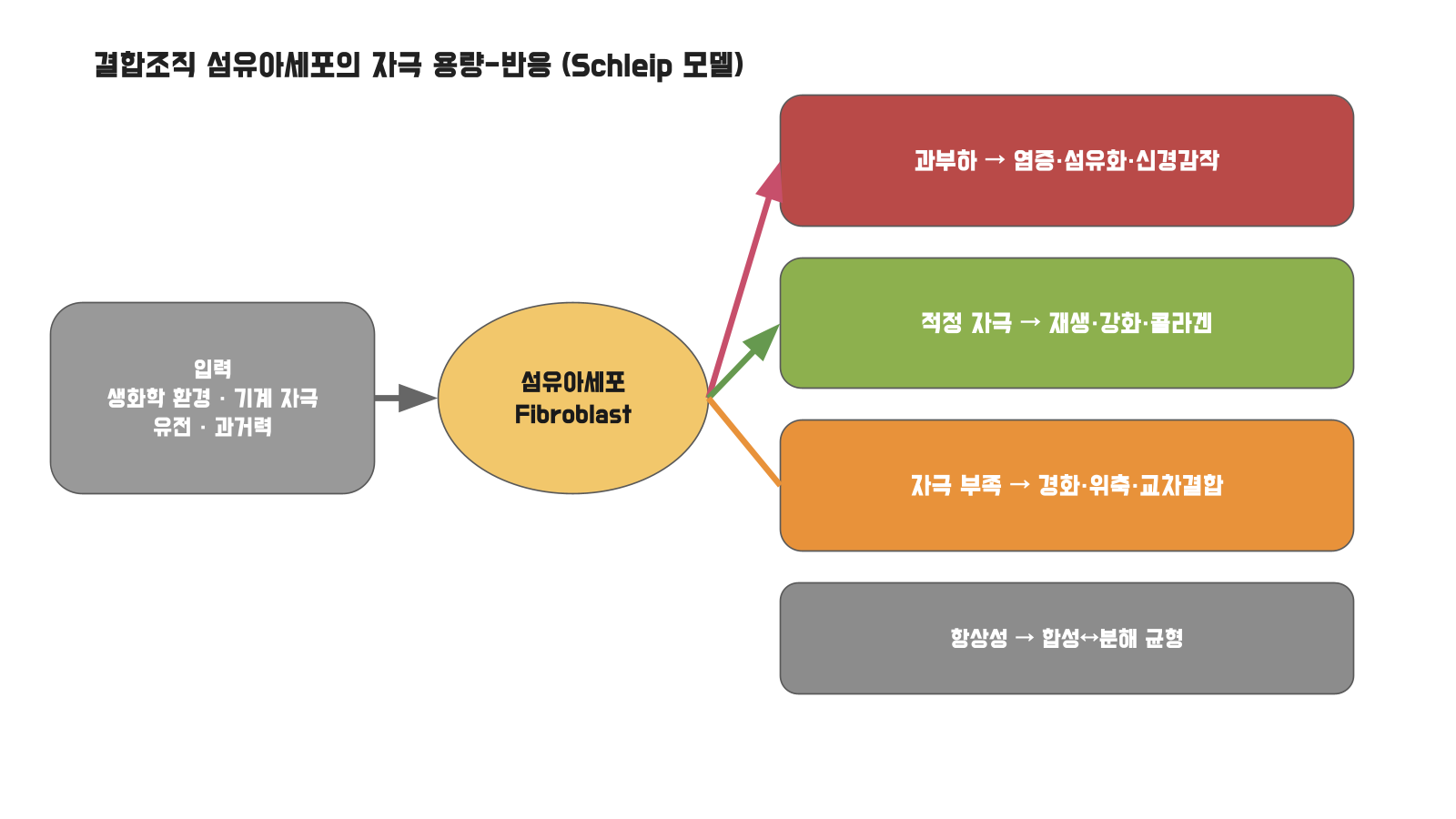
Mechanical stimulus upregulates TGF-β1 and type-I collagen in fibroblasts (PMC4509256). The response is not linear, however. In a three-dimensional culture, increasing strain amplitude promoted proliferation and myofibroblast transition (the marker of fibrosis) simultaneously, with proliferation reaching roughly 2.5-fold at 12% strain (Sci Rep, 2022). In the absence of load, tissue loses both strength and fiber alignment, a state termed stress-shielding. M1 macrophages switch phenotype at strains as low as 3% (Babaniamansour et al., 2023), and ligament fibroblasts have an identifiable window of optimal strain (PMC4976179). Schleip consolidated these findings into a single model: fibroblasts continuously adapt the form of connective tissue to the loads repeatedly placed on it (Schleip & Müller, 2013; Schleip & Baker, Fascia in Sport and Movement). Within the intermediate band, the matrix maintains a working equilibrium, remodeling according to its loading history and genetics, accelerated by use and retarded by disuse (Cowin, 2004).
3-2. What a Needle Is—A Dosed Mechanical Signal
Langevin and colleagues proposed that deukgi (得氣, "obtaining qi," the heavy grip felt during needling) and the physical "needle grasp" both arise where the needle couples mechanically to connective tissue, transmitting a signal the cells can read (Langevin et al., 2001). When the needle is rotated, subcutaneous fibroblasts spread and remodel their cytoskeleton. The effect peaks at two revolutions and decreases with further rotation (Langevin et al., 2006). A needle is therefore a dosing device for mechanical stimulus: beyond a certain point, more rotation produces less response.
3-3. External Treatment ①—The Mechanical Axis: Intensity and Mode of Action
The mechanical axis comprises two distinct variables. The first is intensity—how strongly a given action is applied. The second is mode of action—what kind of work the tip performs.
(a) Intensity. The filiform needle (毫鍼, hochim, the standard fine acupuncture needle) is conical and blunt; it stimulates by deforming tissue as it advances. Four parameters scale its intensity: number of rotations (peaking at two, per Langevin), depth, gauge, and force. Depth has clinical support: in shoulder myofascial pain, deep needling (深刺, simja) was superior to a superficial 2-mm puncture (淺刺, cheonja) at the end of treatment and at one- and three-month follow-up (Ceccherelli et al., 2001). Force shows the same pattern, with high-intensity electroacupuncture raising pressure-pain thresholds significantly above placebo (Barlas et al., 2006). Gauge has not been isolated in a dedicated trial, but a thicker needle deforms more tissue and produces a larger needle-grasp area, so the inference is mechanical rather than speculative.
(b) Mode of action. Added intensity does not change what a blunt tip can do. It presses; it cannot cut. The dochim (刀鍼, the blade-needle) ends in an edge and is used to sever and release adhesions in fascia and ligament. This is a distinct operation, not a stronger one. A hardened adhesion lies in the under-stimulated band—stress-shielded, beyond the reach of any needle that only presses, and a thick filiform needle will not release it; a hardened adhesion must be cut, not pushed. Light adhesions may loosen under a thick filiform needle, but hardened ones require the edge. The function of the dochim is to cut a path back into tissue that stimulus can no longer reach. Only once that path is open can the therapies that follow (② and ③) take effect.
(c) Duration. Thread-embedding (埋線, maeseon) places an absorbable thread at the acupoint, leaving a low-intensity stimulus in situ for days to weeks. The evidence is limited; acupoint thread-embedding for chronic low back pain remains at the protocol stage (Zhong et al., 2022).
In summary, the filiform needle sets intensity, the dochim sets mode of action, and thread-embedding sets duration.
3-4. External Treatment ②—The Thermal Axis: Heated Fire-Needling
Heated fire-needling proceeds as follows: once the needle is inserted, its handle (針柄) is heated, and the heat travels down the shaft to the deep ligament and fascia. The surface is not burned; heat is delivered inward while skin injury is minimized. The warm-needling family is supported by meta-analysis: in knee osteoarthritis it was superior to other traditional treatments in effective rate, pain, and function (Jin & Guan, 2022). On the dose-response curve, heated fire-needling targets the intermediate band, delivering a sustained, measured thermal stimulus that promotes blood flow and collagen renewal in tissue requiring strengthening.
3-5. External Treatment ③—The Pharmacological Axis: Bee-Venom and Herbal Pharmacopuncture
The third axis is defined by what is injected. Bee-venom pharmacopuncture and herbal pharmacopuncture act through different mechanisms, and herbal pharmacopuncture itself spans a wide range.
Bee-venom acupuncture (蜂鍼, bongchim) acts through chemical, immune, and neural pathways. Melittin, the principal component of bee venom, inhibits NF-κB, proposed as the basis of its anti-inflammatory and anti-arthritic effect (Son et al., 2007; Bhardwaj et al., 2025). Its analgesia is attributed to central mechanisms, including spinal opioid and α2-adrenergic pathways, descending serotonin, and suppression of c-Fos (Son et al., 2007). On the dose-response curve, bee-venom acupuncture brings overloaded tissue—inflamed and sensitized—back toward the intermediate band.
Herbal pharmacopuncture (藥鍼, yakchim) is not a single therapy. Its action depends on the injected herb, formulation, and concentration, and resists reduction to one mechanism. Its expected actions run in three directions, weighted differently across preparations. The first is physical: volume and lavage. The injected fluid separates adhered soft tissue and dilutes and flushes local inflammatory byproducts. This appears to be a property not specific to herbal pharmacopuncture but shared by injection procedures generally. (For comparison, reviews of ultrasound-guided hydrodissection in conventional medicine describe injected fluids such as saline and dextrose mechanically separating and decompressing trapped nerve and soft tissue; Buntragulpoontawee et al., 2021.) The second is pharmacological: preparations for which an anti-inflammatory or other active effect is proposed, bee-venom pharmacopuncture being the clearest example. The third is regenerative. Where the aim is to rebuild and strengthen collagen, the evidence is stronger for two lines in particular: jahage (placental extract) and salmon-DNA, or PDRN. Jahage pharmacopuncture is under study in chronic musculoskeletal pain (Kim et al., 2020). PDRN—studied as an injectable rather than a Korean-medicine pharmacopuncture—has been shown to restore collagen synthesis and tensile strength in animal tendon injury (Kang et al., 2018) and to improve tendon healing while reducing fatty degeneration in rotator-cuff repair (Hwang et al., 2021). This indicates which line to consider when regeneration is the aim; it is not a claim that all pharmacopuncture regenerates. Characterizing all pharmacopuncture as "regeneration by pharmacology" is as inaccurate as dismissing it as "mere lavage." It is a wide spectrum, weighted differently across physical, anti-inflammatory, and regenerative action, operating across the curve from the overload band (lavage, anti-inflammation) to the intermediate band (regeneration).
3-6. Internal Treatment—Adjusting the Left Side of the Curve with Herbal Medicine
The left side of the schema represents a second input: the biochemical environment, genetics, and prior history. When this environment is poor, the same stimulus tilts toward overload. Obesity is a state of chronic low-grade inflammation in which adipokines contribute to tendinopathy, and weight loss improves symptoms (Castro et al., 2016). Obesity and metabolic syndrome share the inflammatory pathways NF-κB and MAPK with musculoskeletal disease (Collins et al., 2018). Pain is a function not of injury size but of neural sensitization, which is governed by the systemic inflammatory environment (Dean et al., 2013). Internal treatment addresses this terrain. Narrowly, Jakyak-gamcho-tang (芍藥甘草湯, a peony-and-licorice decoction) relieves muscle spasm and tension (Ai et al., 2006; Mitsumoto et al., 2023), and formulas such as Bosinji (a multi-herb formula evaluated for lumbar disc herniation; Goo et al., 2018) and Palmi-jihwang-hwan (八味地黃丸, the eight-ingredient rehmannia pill) appear in clinical studies of low back and radiating pain (Goo et al., 2018; Sung et al., 2019). Broadly, constitutional and fasting detoxification "clear"—empty—the systemic inflammatory and metabolic burden, after which a constitution-matched formula supplies the basis for regeneration. In this sequence, clearing the systemic inflammatory burden necessarily precedes restorative treatment: regenerative input applied to an unaltered inflammatory environment reverts to the overload band.
3-7. Synthesis—Six Stages on the Curve
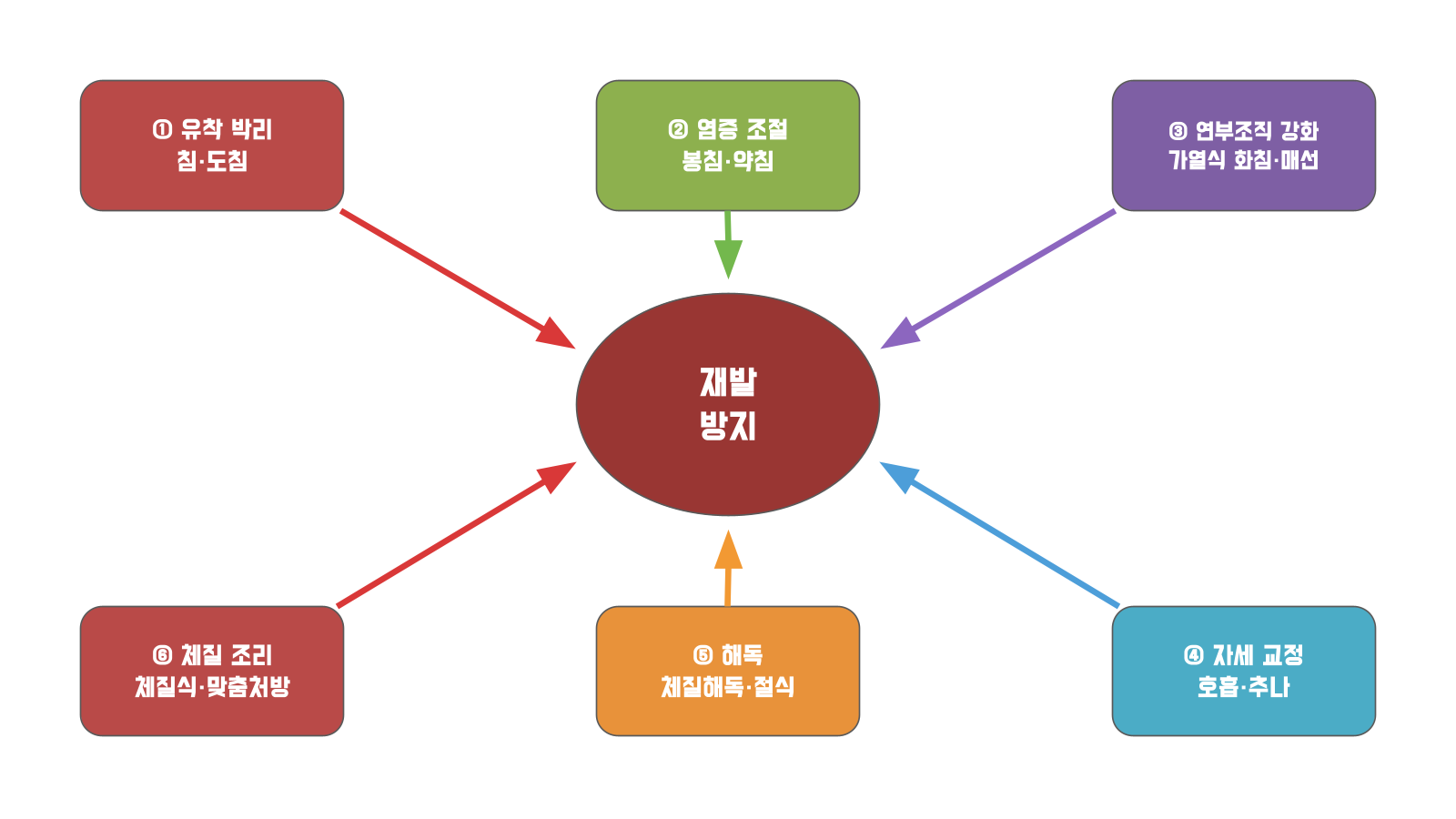
Stages ① through ③ are local external treatment, ④ is the loading pattern, and ⑤ and ⑥ are internal treatment. Pain that "returns once the stimulus stops" occurs when treatment halts at ① through ③, addressing only the local site, and leaves ⑤ and ⑥—the systemic environment—unaddressed.
4. Discussion
| Category | Range of Action | Pathway |
|---|---|---|
| External—mechanical (intensity) | Local, immediate | Dose variation (rotation, depth, gauge) |
| External—mechanical (mode of action) | Local, immediate | Cutting and release (dochim) |
| External—thermal | Local, deep | Sustained deep heat (heated fire-needling) |
| External—pharmacological | Local–systemic border | Lavage, anti-inflammation, regeneration (bee-venom, pharmacopuncture) |
| Internal | Systemic, foundational | Adjusting the metabolic and inflammatory environment (herbal medicine, detoxification, constitutional regulation) |
External treatment moves a single point along the curve; internal treatment tilts the coordinate plane on which the curve is drawn. Bee-venom acupuncture straddles the two: external in delivery, yet chemical and neural in action. In the classical vocabulary, dispelling pathogenic factors (祛邪, geosa) corresponds to clearing the overloaded tissue and the left-side environment, while reinforcing healthy qi (扶正, bujeong) corresponds to supplying the basis for regeneration. To the obvious objection—if a thick filiform needle suffices, is the dochim unnecessary?—intensity and mode of action belong to different dimensions, and cutting a hardened adhesion cannot be replaced by increased stimulus dose. By weight of evidence, ①③④ and ② (bee-venom acupuncture in particular) rest on relatively firm ground, whereas ⑤⑥ and thread-embedding have direct evidence weaker than their mechanistic coherence would suggest, and are set apart as a hypothetical extension.
5. Limitations
- The schema follows Schleip's model, but its application to Korean medicine is an interpretation requiring further verification.
- With mediclassics.kr inaccessible, direct collation of the classical Chinese of the Bi-ron (痺論) and Gyeong-geun (經筋) was not possible, and they are cited only by title and annotation.
- Depth (Ceccherelli) and force (Barlas) are supported by evidence; gauge alone is not, and is argued as a self-evident inference.
- No quantitative criterion distinguishes the filiform needle from the dochim; the matter rests on clinical judgment.
- Pharmacopuncture varies widely in formulation and herb, so the three-fold classification—physical, anti-inflammatory, regenerative—is an illustration of the spectrum, not an exhaustive account; the cited PDRN and hydrodissection studies concern conventional injectables and are drawn on only by analogy.
- RCTs of the direct pain effect of ⑤ and ⑥ are unconfirmed; the reasoning is indirect, proceeding through systemic inflammatory and metabolic mechanisms.
- There is no method for converting the strain amplitudes of the cell model (3, 6, 12%) into an acupuncture dose.
6. References
Khan KM, Scott A. 2009. Br J Sports Med 43(4):247-252. https://doi.org/10.1136/bjsm.2008.054239
Sci Rep 2022. https://doi.org/10.1038/s41598-022-20383-5
Babaniamansour P, et al. 2023. Tissue Eng Part A 30(7-8):314-329. https://doi.org/10.1089/ten.TEA.2023.0110
PMC4976179 (인대 최적 변형 파라미터)
PMC4509256 (기계자극 → TGF-β1·1형 콜라겐)
Dean BJF, et al. 2013. Clin Orthop Relat Res 471(9):3036-3046. https://doi.org/10.1007/s11999-013-3010-y
Langevin HM, et al. 2001. FASEB J 15(12):2275-2282. https://doi.org/10.1096/fj.01-0015hyp
Langevin HM, et al. 2006. J Cell Physiol 207(3):767-774. https://doi.org/10.1002/jcp.20623
Ceccherelli F, et al. 2001. Acupunct Electrother Res 26(4):229-238. https://doi.org/10.3727/036012901816355938
Barlas P, et al. 2006. Pain 122(1-2):81-89. https://doi.org/10.1016/j.pain.2006.01.012
Chen H, et al. 2024. Curr Pain Headache Rep 28(7):709-722. https://doi.org/10.1007/s11916-024-01242-6
Liu CY, et al. 2024. BMJ Evid Based Med 29(6):374-384. https://doi.org/10.1136/bmjebm-2023-112626
Jin S, Guan X. 2022. Ann Palliat Med 11(2):708-716. https://doi.org/10.21037/apm-21-3972
Zhong G, et al. 2022. Medicine 101(52):e32409. https://doi.org/10.1097/MD.0000000000032409
Son DJ, et al. 2007. Pharmacol Ther 115(2):246-270. https://doi.org/10.1016/j.pharmthera.2007.04.004
Bhardwaj V, et al. 2025. Naunyn Schmiedebergs Arch Pharmacol 398(8):9797-9815. https://doi.org/10.1007/s00210-025-03991-6
Goo B, et al. 2018. Medicine 97(50):e13684. https://doi.org/10.1097/MD.0000000000013684
Sung WS, et al. 2019. Trials 20(1):778. https://doi.org/10.1186/s13063-019-3776-7
Ai M, et al. 2006. World J Gastroenterol 12(5):760-764. https://doi.org/10.3748/wjg.v12.i5.760
Mitsumoto H, et al. 2023. Trials 24(1):449. https://doi.org/10.1186/s13063-023-07424-8
Castro AAE, et al. 2016. Arq Bras Cir Dig 29(Suppl 1):107-110. https://doi.org/10.1590/0102-6720201600S10026
Collins KH, et al. 2018. Front Physiol 9:112. https://doi.org/10.3389/fphys.2018.00112
『황제내경·소문』 痺論 / 『영추』 經筋 / 『동의보감』 외형편 筋 (서명·병기 수준)
Schleip R, Müller DG. 2013. J Bodyw Mov Ther 17(1):103-115. https://doi.org/10.1016/j.jbmt.2012.06.007 (+ Schleip & Baker, 『Fascia in Sport and Movement』 — 도식 직접 수록처)
Cowin SC. 2004. Annu Rev Biomed Eng 6:77-107. https://doi.org/10.1146/annurev.bioeng.6.040803.140250
Buntragulpoontawee M, et al. 2021. Front Pharmacol 11:621150. https://doi.org/10.3389/fphar.2020.621150
Kim J, et al. 2020. Trials 21(1):525. https://doi.org/10.1186/s13063-020-04442-8
Kang SH, et al. 2018. J Orthop Res 36(6):1767-1776. https://doi.org/10.1002/jor.23796
Hwang JT, et al. 2021. Tissue Eng Regen Med 18(6):1009-1020. https://doi.org/10.1007/s13770-021-00378-5